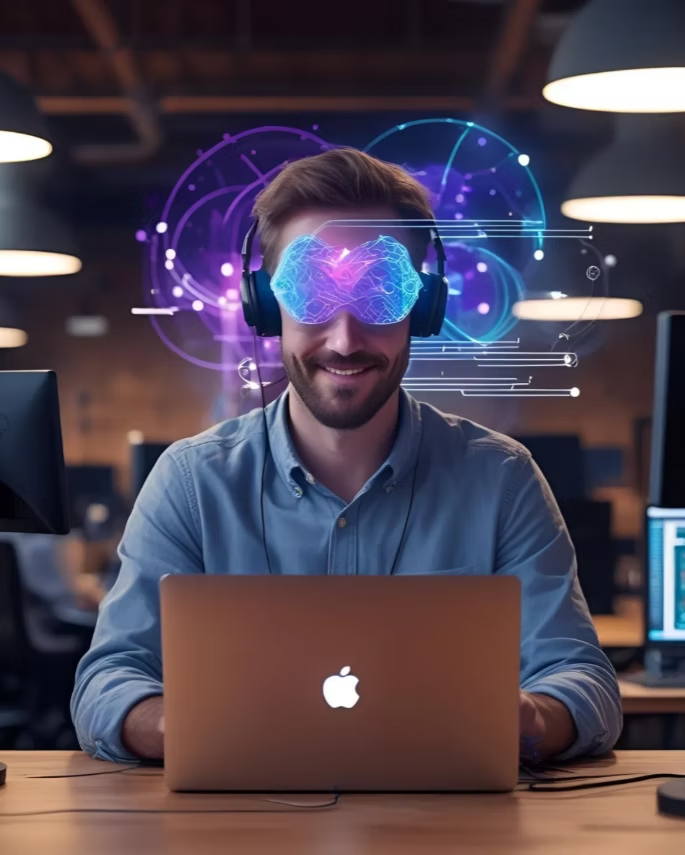
Vibe Coding is an innovative software development paradigm, driven by advances in artificial intelligence, particularly conversational and generative AI technologies. Conceived by Andrej Karpathy, Vibe Coding represents a significant shift from traditional coding practices, allowing developers to collaborate interactively with AI tools in a conversational manner, enhancing productivity, creativity, and accessibility in software development.
What is Vibe Coding?
Vibe Coding involves developers engaging in conversational interactions with AI assistants to iteratively build and refine software. Instead of manually writing detailed code, developers express their ideas and objectives through natural language and receive dynamically generated code suggestions and solutions from AI. This collaborative process streamlines software development, making it intuitive and accessible to a broader audience.
Core Principles of Vibe Coding
-
Iterative Interaction: Developers continuously converse with AI systems, progressively refining and enhancing the codebase.
-
Creative Collaboration: Emphasizes idea-driven interactions, reducing the emphasis on syntax and technical details.
-
Accessibility: Simplifies the coding process, enabling participation from non-programmers or those with limited coding experience.
Advantages of Vibe Coding
Accelerated Development Cycles
By utilizing AI-driven suggestions, developers significantly reduce the time spent writing and debugging code. The iterative conversational model facilitates rapid prototyping, enabling faster progression from concept to functional software.
Lowering Entry Barriers
Vibe Coding democratizes software development by allowing individuals without extensive programming backgrounds to participate effectively. This opens up opportunities for interdisciplinary collaboration and innovation across various fields.
Enhanced Creativity
The conversational aspect of Vibe Coding encourages developers to explore and experiment freely. By abstracting away technical complexities, developers can focus more on high-level creative ideas and innovative problem-solving approaches.
Real-World Applications
Startup Acceleration
Startups leveraging Vibe Coding can quickly prototype and test products, significantly accelerating the development lifecycle. Rapid iteration enables startups to refine their offerings swiftly, reducing time-to-market and improving competitiveness.
Collaborative Coding Environments
Vibe Coding enhances collaboration among diverse team members, including designers, marketers, and engineers. This inclusive approach allows teams to seamlessly incorporate varied perspectives and skill sets into software development processes.
Educational Tools
Educational institutions utilize Vibe Coding to teach programming concepts more effectively. By engaging students through natural language interactions, educators can foster deeper understanding and stronger retention of coding principles.
Challenges and Considerations
Despite its numerous advantages, Vibe Coding presents specific challenges:
Dependence on AI Accuracy
The effectiveness of Vibe Coding relies heavily on the accuracy and reliability of AI-generated suggestions. Errors or inaccuracies in AI output can lead to faulty software, emphasizing the need for careful oversight and validation.
Potential Oversimplification
Simplifying coding processes may inadvertently obscure important technical details, potentially leading to gaps in developers’ knowledge. Striking a balance between ease of use and technical proficiency remains critical.
Ethical and Intellectual Property Concerns
AI-driven code generation raises questions regarding intellectual property ownership and ethical use of generated content. Clear guidelines and regulations must be established to manage these complex legal and ethical issues.
The Future of Vibe Coding
Advanced AI Integration
As AI technologies continue to advance, Vibe Coding will incorporate increasingly sophisticated models capable of understanding complex instructions and generating high-quality, optimized code.
Expanded Industry Adoption
Vibe Coding’s potential spans numerous industries, including healthcare, finance, entertainment, and education. Widespread adoption will lead to significant productivity gains and innovation across sectors.
Regulatory and Ethical Frameworks
Future developments will likely include clearer regulatory frameworks addressing intellectual property, ethical standards, and data privacy considerations. Organizations and developers must proactively engage with these emerging regulations to maximize benefits responsibly.
Conclusion
Vibe Coding represents a groundbreaking shift in software development, leveraging conversational AI to enhance productivity, accessibility, and creativity. By facilitating intuitive, iterative interactions between humans and AI, Vibe Coding promises to revolutionize how software is conceptualized, developed, and deployed. Embracing this novel approach positions developers and organizations at the forefront of technological innovation, driving significant advancements across the digital landscape.