
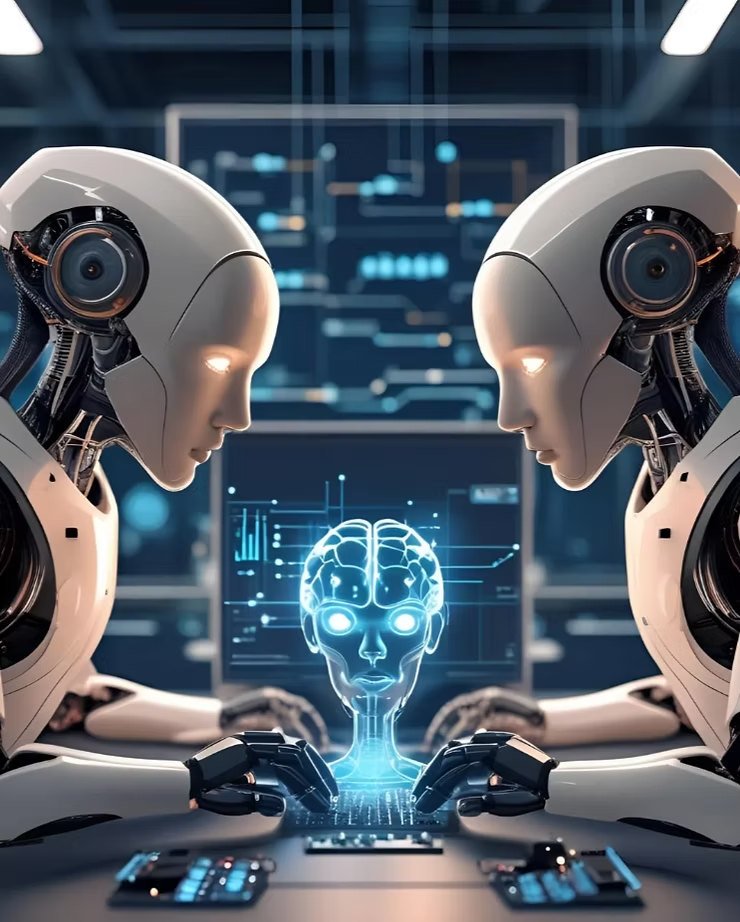
Prompt engineering is rapidly evolving, transforming the landscape of artificial intelligence (AI) interactions. Among the most groundbreaking innovations is the emergence of Multi-Agent Large Language Models (LLMs). These advanced AI systems act like a cohesive think tank, collaborating behind the scenes to provide faster, more accurate, and highly reliable responses — all while hiding their complex inner workings from the user.
Understanding Multi-Agent Systems
A multi-agent system combines multiple AI models, each specializing in different tasks. Unlike traditional single-model setups, multi-agent LLMs distribute queries based on the specific strengths of individual models. By functioning as a coordinated group, these models maximize efficiency and accuracy.
This synergy between multiple agents ensures that tasks are handled by the most appropriate LLM, significantly improving overall system performance.
The Invisible Workflow Behind Prompt Creation
To users, interacting with a multi-agent LLM system feels straightforward and intuitive. However, behind this simplicity lies a sophisticated network of AI agents rapidly assessing, routing, and processing queries.
When a prompt is received:
- The system evaluates the query.
- Agents quickly decide which specialized LLMs are best suited for each task component.
- Tasks are simultaneously executed by these LLMs.
- Results are cross-verified by other agents to ensure accuracy.
- The refined, optimized response is swiftly delivered back to the user.
This entire workflow happens seamlessly, invisible to the end-user.
Optimizing for Accuracy with Multiple Models
In traditional single-agent LLM systems, accuracy often suffers because a single model must handle diverse queries, leading to increased likelihood of incorrect or inconsistent outputs — known as “hallucinations.”
In contrast, multi-agent systems tackle accuracy strategically:
- Specialization: Different agents handle tasks aligned with their specific strengths, such as precision, general knowledge, technical expertise, or creative generation.
- Cross-validation: Agents actively cross-check each other’s outputs, identifying discrepancies early.
- Consensus-building: Models collaboratively refine their responses, creating a consensus-driven, accurate final output.
The Fastest LLM: Rapid Response Capabilities
Speed is a vital component of any LLM system. In multi-agent architectures, specialized “fast-response” agents rapidly manage simpler or straightforward queries. These agents excel at delivering immediate, precise responses without extensive computational overhead.
When a user submits a query requiring rapid feedback, it’s instantly routed to these agile models, ensuring minimal latency and instant user satisfaction.
Teamwork Among Agents to Reduce Latency
Latency — the delay between input and output — often frustrates users. Multi-agent LLM systems dramatically reduce latency by dividing tasks among multiple agents operating simultaneously.
Here’s how they achieve this efficiency:
- Parallel Processing: Tasks are handled concurrently, with each LLM performing distinct aspects of the query simultaneously.
- Dynamic Task Routing: Queries are assessed and dynamically routed to agents based on real-time availability, load balancing, and specialization.
- Optimized Resource Utilization: Efficient use of computational resources ensures agents respond swiftly and effectively.
Real-World Examples of Multi-Agent Synergy
Consider the following examples where multi-agent LLM systems dramatically improve performance:
Customer Support:
- Simple customer queries (“What are your opening hours?”) are instantly resolved by rapid-response LLMs.
- Complex troubleshooting tasks (“Help me fix my technical issue”) are simultaneously routed to specialized technical agents who collaboratively refine responses.
Financial Services: - Fast agents handle immediate queries about balances and simple transactions.
- Specialized financial LLMs perform detailed analyses for more complex financial advisory prompts, cross-validated by general-purpose agents to guarantee accuracy.
Enhanced Reliability through Collaborative Agents
Reliability is critical in AI-driven interactions. Multi-agent LLMs inherently enhance reliability through built-in redundancy and collaborative validation:
- Redundancy: Having multiple specialized models addressing the same or related tasks minimizes single points of failure.
- Collaborative Validation: Cross-validation among agents ensures incorrect responses are swiftly identified and corrected.
- Continuous Learning: Multi-agent systems continuously learn from each other, refining their collective reliability through ongoing feedback loops.
Why Users Never Notice the Complexity
A critical feature of effective AI systems is their ability to hide complexity from the user. In multi-agent LLM systems, users benefit from sophisticated, accurate, and fast responses without experiencing the intricate processes involved:
- Seamless User Experience: Users interact with a single, intuitive interface, unaware of the multiple agents actively processing their queries.
- Effortless Interaction: The advanced technology stays hidden, letting users effortlessly receive accurate and reliable AI-generated responses.
Looking Forward: Future Developments
The future for multi-agent LLM systems is bright. Emerging developments include:
- Adaptive Agent Coordination: Advanced algorithms will further refine agent collaboration, dynamically adjusting task routing based on evolving circumstances and learned behaviors.
- Energy-Efficient AI Architectures: Optimizing computational resources to deliver even faster responses while consuming fewer resources.
- Personalized Agent Systems: AI agents that adapt to individual user preferences and behaviors, offering hyper-personalized interaction experiences.
Conclusion: Reliability Reimagined
Multi-agent LLM systems have revolutionized prompt engineering, significantly boosting the accuracy, speed, and reliability of AI interactions. By acting as a cohesive, invisible think tank, these systems deliver remarkably consistent and trustworthy results, effortlessly enhancing user experiences across various industries.
In the coming years, continued advancements in multi-agent architectures will further cement their essential role in driving seamless, reliable, and rapid AI-driven interactions.
FAQs
1. What makes multi-agent LLM systems superior to single-model setups? They leverage multiple specialized AI models, simultaneously improving speed, accuracy, and reliability compared to single-model alternatives.
2. How do multi-agent LLM systems speed up responses? Tasks are executed in parallel by specialized agents, dynamically routing simpler queries to rapid-response LLMs and complex queries to specialized models for swift processing.
3. Do users notice when multiple agents handle their queries? No. Users interact with a single, simple interface, unaware of the multiple specialized agents collaborating behind the scenes.
4. Can multi-agent LLM systems reduce AI hallucinations? Yes. Through cross-validation and collaborative consensus-building among agents, incorrect or nonsensical outputs are swiftly identified and corrected.
5. What’s next for multi-agent LLM technology? Future developments will include more adaptive coordination among agents, enhanced energy efficiency, and increased personalization for user-specific experiences.