Understanding AI and Automation
What is Artificial Intelligence?
Artificial intelligence (AI) refers to machines programmed to perform tasks traditionally done by humans. Imagine AI as your digital assistant — just smarter. It learns, adapts, and evolves through experiences. This allows it to tackle increasingly complex tasks such as medical diagnosis, financial analysis, and even creative pursuits like painting or writing. AI’s most significant advantage lies in its ability to process massive datasets quickly, accurately, and tirelessly, outperforming human capabilities in specific domains.
Types of AI: Narrow, General, and Super AI
AI comes in different flavors. First, there’s Narrow AI — specialized in one task like facial recognition or voice assistants like Siri. Then we have General AI — machines that possess human-like intelligence and versatility. While still theoretical, General AI represents the goal for many researchers. Finally, Super AI surpasses human intelligence entirely and could theoretically outperform humans in every aspect. Although still speculative, the mere possibility excites and terrifies industry leaders alike, raising questions about our role in an AI-driven world.
Industries Most Affected by AI
Manufacturing and Automation
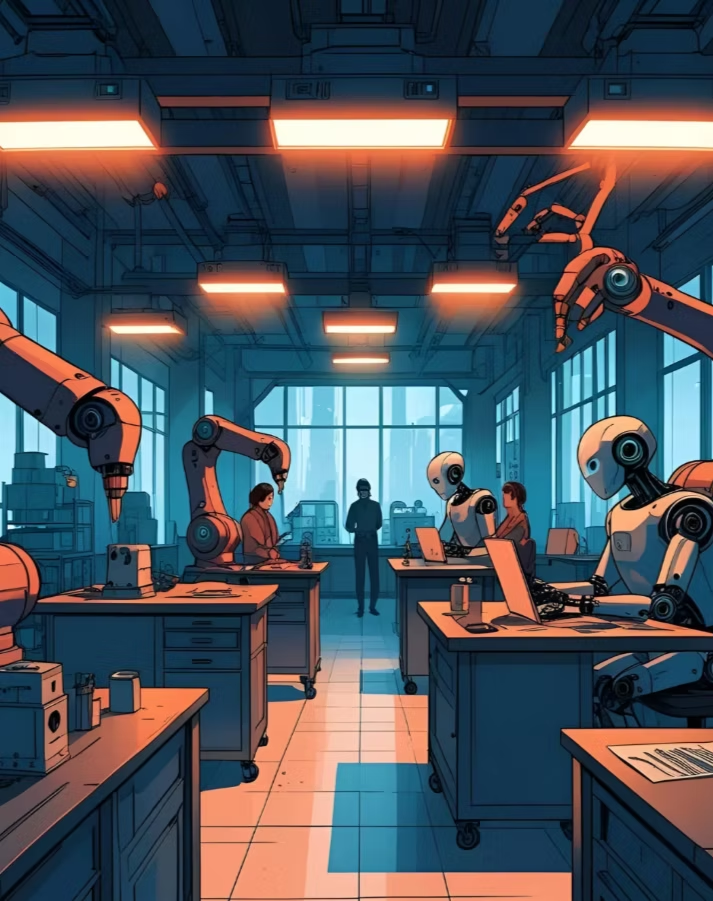
Manufacturing is no stranger to automation. Robots have taken over repetitive, mundane tasks, freeing humans for more complex roles. AI-enhanced robots are now operating with unprecedented precision, drastically reducing errors and increasing productivity. Take the automotive industry, where robots efficiently assemble vehicles with near-perfect accuracy, significantly improving efficiency and lowering operational costs. Yet, as these automated systems proliferate, traditional manufacturing jobs diminish, creating anxiety around employment stability.
Transportation and Autonomous Vehicles
Self-driving cars and autonomous trucks symbolize AI’s potential in transportation. Companies like Tesla and Waymo are pushing boundaries with AI-driven navigation systems, promising safer roads and lower transportation costs. However, this advancement poses a direct threat to millions of jobs in trucking, taxi services, and logistics. While autonomous technology promises efficiency, the transition might leave many behind without proper preparation and retraining.
Customer Service and Chatbots
Remember calling customer service and enduring endless wait times? AI-powered chatbots have transformed that experience. Today, chatbots manage routine inquiries efficiently, offering instant assistance 24/7. Companies benefit from reduced costs and increased customer satisfaction. Yet, many worry about the human side of customer service disappearing entirely. While bots handle routine questions effectively, complex emotional interactions still demand human sensitivity and empathy.
Positive Impacts of AI on Employment
Creation of New Job Opportunities
While AI may eliminate certain roles, it simultaneously opens doors to entirely new jobs. Fields like AI maintenance, cybersecurity, data science, and AI ethics are booming. Professionals skilled in managing, maintaining, and optimizing AI systems are in high demand. In fact, the World Economic Forum predicts millions of new roles emerging by 2030 due to AI advancements. It’s not about job loss — it’s about job transformation.
Enhanced Productivity and Efficiency
AI boosts productivity dramatically. Automating routine tasks allows workers to focus on strategic, creative, and interpersonal activities. Companies utilizing AI effectively witness growth through increased innovation and improved resource management. Imagine a scenario where AI manages data analysis instantly, freeing professionals to strategize, innovate, and make informed decisions rapidly. This increased efficiency significantly contributes to business growth and economic development.
Negative Impacts of AI on Employment
Job Displacement and Unemployment Risks
The rise of AI undeniably raises alarms about widespread job displacement. Tasks that require repetitive, predictable actions — such as data entry, telemarketing, and even basic accounting — are rapidly becoming automated. A McKinsey report predicts that around 400 million jobs globally could be automated by 2030, causing massive shifts in employment patterns. The uncertainty and stress this creates can’t be overstated; workers across industries worry about their job security and livelihood. Automation isn’t selective — AI doesn’t consider human factors like mortgages, family responsibilities, or community ties. This blind spot could exacerbate unemployment rates, especially among lower-skilled workers who have fewer opportunities for retraining.
Increased Economic Inequality
As AI adoption accelerates, economic disparity could widen significantly. Technological advancement tends to disproportionately benefit high-income, highly skilled workers who can leverage AI to enhance their roles. Conversely, lower-skilled workers face greater displacement and limited access to the resources needed for retraining or upskilling. This divide creates a “winner-takes-all” scenario where wealth accumulates at the top, leaving the middle and lower classes further behind. Moreover, developing nations with limited technological infrastructure could experience even greater economic disparity, intensifying global inequality and social unrest. Policymakers must proactively address these inequalities through inclusive policies and equitable access to AI benefits.
Preparing the Workforce for an AI-driven Future
Importance of Reskilling and Upskilling
With AI reshaping employment landscapes, reskilling and upskilling become crucial. Workers must adapt to evolving demands by acquiring new skills — such as data literacy, machine learning, critical thinking, and emotional intelligence. Organizations and governments alike have roles to play in facilitating accessible training programs. Initiatives like Google’s Career Certificates or IBM’s SkillsBuild demonstrate proactive corporate engagement in workforce training. Encouraging lifelong learning, providing financial incentives, and creating accessible educational programs will be essential. Reskilling isn’t merely beneficial; it’s essential for economic survival in an AI-centric world.
Educational Reforms Needed
To effectively integrate AI into society, education systems must evolve radically. Current curricula often lag behind technological advancements, leaving graduates unprepared for AI-driven workplaces. Schools should emphasize digital literacy, programming fundamentals, and ethical AI use starting from early education levels. Additionally, soft skills such as creativity, problem-solving, adaptability, and emotional intelligence need greater attention. Universities must collaborate closely with industries to provide practical experiences through internships and project-based learning. Progressive educational policies, embracing continual updates and collaboration with industry leaders, are crucial for preparing students for the rapidly changing employment landscape.
The Ethical Dilemma: AI and Human Collaboration
Balancing AI Integration with Human Workforces
Striking a balance between AI and human labor is one of the most pressing ethical dilemmas of our era. While businesses are keen to capitalize on AI’s efficiency and cost savings, human factors like job satisfaction, mental health, and economic stability can’t be ignored. AI should complement — not replace — human workers. Businesses must foster collaborative environments where AI handles repetitive, data-driven tasks, allowing humans to leverage their creativity, empathy, and strategic thinking. Emphasizing ethical frameworks ensures that AI applications benefit society as a whole rather than creating divisions. Transparent policies, inclusive decision-making, and clear communication about AI integration strategies can alleviate worker anxiety and foster a cooperative, productive workforce.
Conclusion
AI’s impact on job markets is profound and multifaceted. While automation threatens traditional jobs, the technology simultaneously creates numerous opportunities for new roles, higher efficiency, and economic growth. To mitigate negative impacts, proactive measures — including reskilling, educational reforms, and ethical frameworks — are essential. Ultimately, AI isn’t about machines replacing humans entirely, but about reshaping employment paradigms. Humans and AI must coexist harmoniously, enhancing each other’s capabilities to forge a future that benefits everyone.
FAQs
-
Will AI completely replace humans in the workforce?
No, AI is likely to automate certain repetitive tasks but will create new roles requiring uniquely human skills like creativity and empathy.
2. What jobs are most at risk due to AI?
Jobs involving repetitive or predictable tasks, like data entry, telemarketing, and basic manufacturing tasks, face the highest risk.
3. How can individuals prepare for an AI-driven workplace?
Individuals should focus on acquiring digital literacy, data analysis skills, critical thinking, and interpersonal skills.
4. Will AI widen economic inequality?
Without proactive policies and equal access to training, AI could indeed exacerbate economic inequality.
5. Are there ethical concerns surrounding AI in employment?